
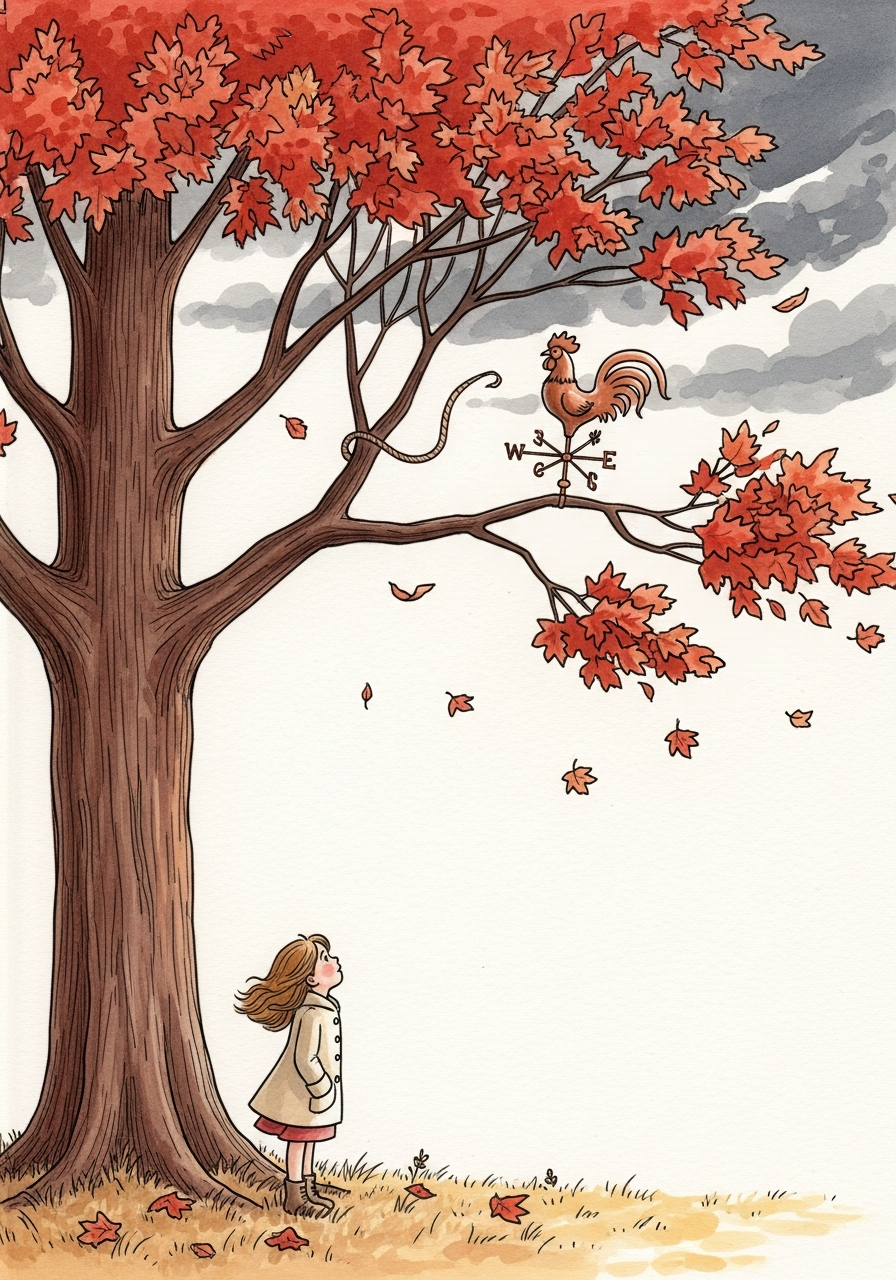
The First Clear Morning
Every October, on the first clear morning, Maple woke up.
She was not a tree the rest of the year. Or she was, but in the way that a person who is asleep is still a person. The rest of the year she was quiet, roots in the ground, leaves going about their business without her. But on the first clear morning in October, Maple opened her eyes (they were somewhere in the curl of her highest branches, if you knew where to look) and she remembered the children.
She remembered every one of them.
The Kirby twins had grown. They were, in fact, a bit too tall now. Maple could see the fence they had hopped last summer, and she did not approve. Eleanor Wren, who had climbed into Maple's lower branches as a girl back when the library was still a one-room house with a drafty door, was an old woman now. She had grown all the way up, and now she tended the library at the other end of the square. Her grandmother's hair had come down to her without permission, along with her grandmother's mouth when she was thinking, and Maple found this delightful. Oliver, who had once borrowed Mr. Ginn's whistle and run the town for a Tuesday, was eleven now. He walked to school with his hands in his coat pockets and his eyes on the sky, and he was very serious about both.
All of this Maple absorbed in one long breath, which took roughly the length of a slow morning.
And then, because she was awake now and had watching to do, she shook herself. Not her whole self. Just her topmost branch. Three or four leaves came loose and drifted down onto the bakery awning across the square.
"Good morning, Pinewood," said Maple.
Nobody heard her except a sparrow, who was unimpressed.
The sparrow was young. She had hatched in Maple's second-lowest fork three springs ago, and she had not yet learned to be unimpressed by anything else. She was working on it.
Maple had been waking up this way, on the first clear morning in October, for as long as any Pinewood grown-up remembered. The town history said she was planted in 1864, which, Maple privately felt, was not quite true. But she didn't correct anyone. It did not matter when she was planted. What mattered was that she was here.
She settled in. The sky was the particular cold blue that only happens in fall. Somewhere behind the library, a dog barked twice and then remembered not to. The bakery chimney put up a thin line of smoke, and the smell of yeast reached her third-lowest branch and was pleasing.
It was going to be a good morning. Maple could already tell.
What she did not know, because she had not yet looked south, was that a storm was coming. A big one.
Alma's Letter
Alma Kirby was not like her cousins.
This was said often enough in the Kirby family that Alma had, by the age of eight, come to think of it as a compliment and a complaint in about equal measure. Her cousins were Maya and Marcus, the twins from Linden Lane, and they were famous in Pinewood for being trouble. Alma was not famous for anything.
But her family did, quietly, consider her to be the Kirby who lost things.
The one other letter she had ever written, to her grandmother at Christmas, had gone into the mailbox without a stamp. She had discovered this two weeks later, when her grandmother phoned to ask, gently, if there was any news. Alma had apologized for a very long time. Her grandmother had said it didn't matter. Later, when Alma's mother picked up the phone, Alma had listened from the stairs and heard her grandmother say that of course it didn't matter, Alma was not a careful child.
Alma had thought about this for most of a year.
On a Friday in late October, after school, she walked through the town square with a letter in her coat pocket. This letter had a stamp. She had checked the stamp six times while walking. She had checked it twice while getting dressed. She had checked it, once more, reaching into her pocket to reassure herself that it was still there. The stamp was still there. The stamp was not going anywhere.
The letter was addressed to a boy named Henry who lived in Portsmouth. She had met him twice: once at a wedding, and once at a christening. At the christening he had given her half of a blue lollipop and told her that Portsmouth had a word for sad that nobody else used, and if she ever needed it she could ask him and he would teach her. She had been, at the time, six. He had been seven. This had seemed to both of them like an enormous, private promise.
She had written the letter the night before, in her cleanest handwriting, and it said things she did not want to say aloud. She had walked to the post office carefully. At the window, Mr. Ginn was asleep at his desk, which was normal. Alma slid her letter through the slot and listened for it to land on the pile on the other side. She had put the stamp on first.
She walked back through the square with a weight off her chest that she had not known she was carrying.
As she passed Maple the second time, a leaf dropped directly in front of her.
Alma looked up.
The leaf was red-gold, veined darker at the edges, and surprisingly large in her hand when she bent to pick it up. It was the kind of leaf a child keeps. Alma put it in her pocket, where it bumped against the place the letter had been.
"Thank you, Maple," Alma said, because that was what Pinewood children said when Maple gave them a leaf.
Maple, who was already watching the south sky, did not say anything back. But if you had been the sparrow on her second-lowest branch, you might have noticed that the curl of her highest branch tightened, just slightly, the way a person tightens their jaw when they realize something.
The letter had a stamp. The post office was a wooden building. The roof tiles were old. The rain, when it came, would be more rain than anyone in Pinewood was expecting.
And Maple had six hours to get ready.
The Storm
The first sign of the storm was the sky changing color.
It happened a little before dinner. Maple watched it carefully. She had seen many storms in her long life. Quiet ones, boring ones, the Year of the Great Lean, when the wind was so strong it taught the trees to bow and had bent her second-largest branch, a disappointing one last September that had been all lightning and no rain. This one was going to be different, she thought. This one was going to be the kind of storm that took things.
She set about her preparations.
Maple could not move, of course. She was a tree. What she could do, and had always been able to do in her peculiar way, was decide what her branches were for. In the quiet eleven months of her year, her branches were for birds and squirrels and the wind that sometimes rested there. In October, on the first clear morning and the days that followed, her branches were for catching.
Catching what? That depended on the storm.
Maple tested her highest branch. She tested her lowest. She tested the crook of her third-lowest, where there was a place the size of a child's palm. She had held a lost mitten there one winter, and a single roller skate one summer (a mystery she had never resolved), and the Wrens' cat for one whole harrowing afternoon. The crook was still good.
She braced.
The rain came at a quarter past nine.
It was not, at first, the kind of rain Maple had been expecting. It was thin. It hissed against her leaves like someone telling her a secret. Underneath the hiss, Pinewood had the wet-metal smell it always had during the first real rain of the fall. Ozone and rust, and something that was almost the smell of distant lightning, which it was. The cobblestones beneath her turned dark, then shiny, then so slick with water that the streetlamps turned them into a second sky, upside down.
Then, around ten, the rain thickened. And at eleven, the wind arrived.
Wind in Pinewood, most of the time, was a lazy animal. This wind was not. This wind had come from somewhere out past Portsmouth, and it was in a hurry to get to somewhere past Hollow Creek, and it did not particularly care what it took with it on the way.
It took a weather vane from Mrs. Hart's bakery. The vane was copper, old, shaped like a rooster. It went up and over and tumbled once in the dark. Mrs. Hart, who was at that moment sitting in her kitchen with a book, felt the change in her house and put down her book and frowned.
It took the cedar shingles from the north corner of the Wrens' library roof, the ones that always smelled of old moss when they got wet. (Maple would be sad about this in the morning. She liked the library.)
It took a yellow watering can out of Mrs. Teacake's garden at the edge of town. Mrs. Teacake, asleep at the time with her cat on her lap, would not know for three days.
It took a cat, briefly, from the front porch of the Olsen house, but the cat scrabbled and the wind thought better of it and dropped her back on the same porch, indignant.
And at a quarter past midnight, as the storm reached its loudest and most ill-tempered hour, it took the south-east corner of the post office roof.
Three roof tiles came loose. Then a fourth. A gap opened above the sorting room, and the wind, which was by now almost laughing, rushed in.
Letters.
Envelopes.
Stamps.
A dozen of them came up into the sky like a scatter of white birds, and the wind took them, and carried them directly, as wind of that sort often does, toward the town square.
Maple was waiting.
The sparrow, who had gone deep into the crook of the second-lowest branch to wait out the storm, was not waiting for anything. She was simply hoping the wind would not remember her. She would, later, tell every other sparrow in Pinewood that she had seen what happened next. They would not believe her.
What the Wind Wanted to Take
The first envelope reached her at twenty-past midnight.
It was a plain white envelope, going to someone named Ellsworth in Albany, and it was heavier than Maple had been expecting. Bills, she suspected. She caught it in her third-lowest branch, in the crook. The envelope stuck there, pinned by the wind, and did not go any further.
The second arrived a moment later, smaller, with a stamp that had a sailing ship on it. Maple caught it in her second-highest.
The third was the one.
Maple knew it the instant it came up into her branches. She could not have said why. Perhaps it was that the envelope was smaller than the others, or that the handwriting on the front was the careful, square, slightly-too-large handwriting of an eight-year-old doing her very best. Perhaps it was simply that she recognized the pocket it had come out of.
It was Alma's letter.
It hit Maple's second-lowest branch, skidded sideways, and nearly kept going into the square. Maple, who had not been asked, and did not care, reached.
She did not have arms. But she did have a hundred and sixty years of practice knowing exactly where her branches ended, and she bent only a little, only a thumb's width, and the letter caught in the fork where the branch split, and stayed.
"Not this one," said Maple, to no one in particular.
And that was when the wind, having pried the copper weather vane off Mrs. Hart's bakery an hour earlier, sent the weather vane at her.
It came across the square spinning. It was copper. It was old. It was shaped like a rooster, which is a cruel shape for a thing to be shaped like when it is going through the air at that speed. It was aimed, as such things are, at nothing in particular. But nothing in particular happened to be exactly where Alma's letter was caught.
Maple saw it coming.
She had a moment. Half a moment. To decide.
She could move her second-lowest branch. She had never done it before in a storm. She had only ever held still and caught what the wind sent her. Moving was harder. Moving hurt. Moving meant choosing.
She moved.
She swung her second-lowest branch up and out, not far, only as far as a tree can swing a limb in a single breath, and she caught the weather vane square across the wood. The branch cracked. Not all the way through. Two thirds of the way. The copper rooster embedded itself in the bark, bent one of its own tail feathers, and stopped.
The letter stayed where it was.
Maple made a sound that the sparrow, listening from the crook, had never heard a tree make before. It was a small sound, and it was private, and the sparrow decided, on the spot, that she would never tell anybody she had heard it. (She did, eventually, but only because she forgot that she had promised not to, and by then she was an old sparrow with a bad memory.)
The storm kept coming. The rain kept coming. Maple, who was now hurting in a way she had not hurt in a very long time, held on.
She caught what else came.
A postcard from Mrs. Kirby to her mother in Ohio, which had been written in February and forgotten on a shelf.
An invoice from Jenkins's General Store for a pound of sugar and a jar of preserves.
A Christmas card, early and hopeful, addressed to the Kirby twins, signed by an aunt they had not seen in a long time.
A thick envelope from the library to a family in Cleveland about an overdue book.
A small blue picture book, also from the library, open to an illustration of a crow.
By two in the morning, her branches held thirteen letters, two envelopes, a postcard, a small blue book, and (inexplicably) a single yellow feather that she did not remember catching at all.
Her second-lowest branch, which was supposed to be holding Alma's letter, was holding it.
The branch was also, now, very badly broken.
The storm moved north.
Pinewood quieted.
Maple, who was tired and hurting and satisfied, settled her other branches carefully around her catch and waited for morning.
The Finding
Alma woke at seven to the sound of her mother already awake, which almost never happened on a Saturday.
There had been a storm, her mother said. Everyone was fine. The roof of the post office had come off, a little, and Mr. Ginn was in the square trying to round up the mail. Would Alma want to walk down with her and see if there was anything she could do?
Alma had a terrible, sinking thought.
She got dressed before her mother finished asking.
The square looked different in the morning after a storm. There were small branches all over the cobblestones, and a weather vane lying in the gutter by the bakery, bent and copper and once shaped like a rooster. Mr. Ginn was standing in front of the post office with a pillowcase. Into it he was putting letters, collecting them with the stooped patience of a man who has done this once before in his life: from the ground, the flower boxes, the gutter, the top of Jenkins's awning, and a surprising number of places he had to climb to reach.
Alma looked at Maple.
Maple was full of letters.
It was the strangest and most beautiful thing Alma had ever seen: the red-gold leaves still mostly on, the branches bowed by the weight of paper, each envelope and card caught in a different place, like a library tree. Mr. Ginn had not gotten to her yet.
Alma looked at Maple again, lower this time.
The second-lowest branch was broken.
It had not fallen all the way. It was hanging by a long strip of pale wood, trailing down toward the cobblestones, and the red-gold leaves on the broken side were already beginning to wilt. Alma, who had grown up in Pinewood and whose mother had pointed up at Maple every year of her life, had never seen a broken branch on this tree. Nobody she knew had ever seen one. It was the kind of thing, she understood without being told, that would go into the Pinewood town history book.
"Mother," said Alma, in a small voice, "can I help get the mail down?"
"Of course you can, sweetheart."
Alma walked across the square. The cobblestones were wet and her shoes were cold. She stood at the base of Maple and looked up.
"Please," she said quietly. Not to her mother, who had walked on ahead. To Maple. "Please tell me it's still here."
A leaf fell. A big one, red-gold, the kind a child keeps. Alma caught it before it hit the ground, and it brushed her fingers and pointed (in the way leaves sometimes seem to point if you are eight and you believe it) at the fork of the second-lowest branch. The broken branch.
Alma stood on her tiptoes.
She pulled down a very small white envelope, addressed in her own careful handwriting, to a boy named Henry in Portsmouth. The stamp was still stuck. The corner was a little bent. It was otherwise perfectly fine.
Alma put it in her coat pocket, next to the leaf.
She stood at the base of Maple for a long, quiet moment, looking at the place where the broken branch was hanging down, and at the copper rooster in the gutter, and at the ground at her feet.
Something small and yellow was sitting in the wet grass beside her shoe.
It was a feather. A goldfinch's, she thought, though she didn't know why she thought that. She picked it up. It was perfectly dry.
"Thank you," Alma said, to Maple, and to the feather, and to whatever had made the two of them meet. She did not know what she was thanking, exactly. But thanks seemed like the right thing.
The sparrow, in the second-lowest branch, watched all of this without moving. The sparrow was having some complicated feelings about trees. She was not yet ready to tell anyone about them. She never would be, quite.
Alma walked back across the square. She gave the rest of the letters, carefully, to Mr. Ginn, who was very grateful and said so several times. As she handed him the last envelope, she slipped the yellow feather into his pillowcase along with it, the way you might tuck a note into a book. Mr. Ginn did not notice. She did not expect him to. It was a thank-you that did not need to be received to be given.
She took her own letter, on the way home, to the new post office window, which was a side door Mr. Ginn had opened because the front was boarded up, and she mailed it again.
This time, it went to Portsmouth without incident.
November
Henry wrote back.
It took eleven days. In the meantime Alma waited, and during that waiting, November arrived, and Maple went quiet. Her leaves fell. All of them, this time, as they always did in the first week of the month. The last leaf of that year came to rest on the doorstep of the library, where Eleanor Wren, who had been Maple's friend her whole life, picked it up and tucked it into a book.
The Pinewood town council, that same week, decided to leave the broken branch where it was, instead of cutting it off. "It'll mend," said old Mr. Teoh, who had been on the council for forty years and had strong feelings about trees. Nobody argued with him. A year later the pale strip of exposed wood had darkened to the color of the rest of the bark, and the only way you could see the break, if you looked for it, was a particular bend in Maple's second-lowest branch that had not been there before. When the wind came strong from the east, the branch creaked a little, the way an old floorboard creaks when it has been walked on for long enough. It was a new sound in Pinewood.
Children in Pinewood, from that November on, called it the Brave Bend.
On the twelfth day after she mailed the letter, Alma came home from school to find a letter on the kitchen table with her name on it. She opened it at the table, with the kind of breathless caution reserved for things that you are pretty sure are about to be the best day of your life.
"Dear Alma," it said.
The rest is none of our business.
But we know this much: that Alma kept the letter, and she kept the red-gold leaf that Maple dropped into her hand on the morning of the storm. And every October, on the first clear morning, when the sky turned its particular cold blue and the bakery put up its thin line of smoke, Alma walked to the square and looked up at Maple, and said good morning.
And Maple, who was paying attention, said good morning back.
The End
A Pinewood Storybook, published by fancy.fyi Press.